Backdrop: A Practical Script Font for Balanced Branding
I was staring at a blank artboard, tasked with refreshing the identity for a local ceramics studio. The owner wanted something that felt handmade but polished, approachable but not overly rustic. My usual stack of sans-serif workhorses felt too cold, and many of my favorite playful scripts seemed too informal. That’s when I opened my type library and clicked on a font I hadn’t tested in a real project yet: Backdrop.
First Impressions on a Logo Draft
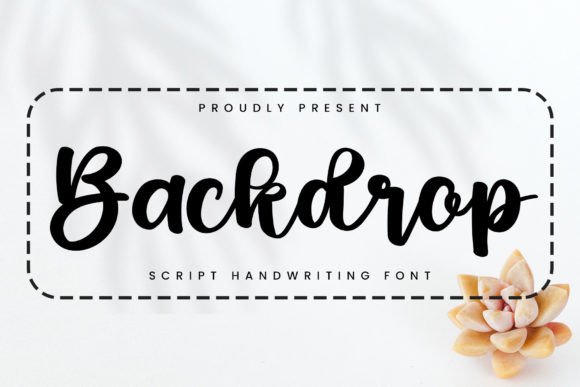
Typing the studio’s name into a logo draft, Backdrop’s personality came through immediately. It’s a bold and expressive script font, but its thick, solid lines create a surprising stability. The conservative bends and curves aren’t overwhelming—they give a sense of motion without feeling frantic or chaotic. This was the balanced fusion of playful and professional I was looking for. The font didn’t scream “handwritten”; it whispered “crafted with care.” On the first business card mockup, it held its weight against a clean sans-serif supporting text, establishing a clear and pleasing visual hierarchy right away.
Where Backdrop Shines in Brand Applications
Over the next few days, I tested Backdrop across the entire brand board. Its performance was consistently strong in specific, high-impact areas.
- Logo & Wordmarks: Its inherent boldness makes it excellent for primary logos or standalone wordmarks. It’s legible even at smaller sizes on social media profile pictures or app icons.
- Packaging & Product Labels: On packaging mockups for the ceramics studio—like a simple soap dispenser or a mug box—Backdrop added personality without sacrificing readability. The thick strokes meant the font didn’t disappear against textured background images.
- Website Headers & Hero Sections: As a display font in website headers, it commands attention while remaining easy to parse. It works beautifully for short, impactful phrases like “Handmade Daily” or “Visit Our Studio.”
- Social Media Graphics: In Instagram post layouts announcing new workshops, Backdrop created engaging titles that felt cohesive with the more professional booking information set in a sans-serif below.
- Business Cards & Stationery: The solid lines print very well, even on uncoated paper stock, maintaining their character and clarity.
In all these applications, Backdrop influenced the brand perception toward confident creativity. It provided a visual anchor that felt consistent, professional, and recognizably unique, helping to engage an audience looking for authenticity with a modern touch.
The Limits & Practical Pairings
Like any specialized typeface, Backdrop isn’t a universal solution. Its bold script nature means it’s not suited for long body text—you wouldn’t set a whole blog post or product manual with it. Readability suffers in dense paragraphs. It also wouldn’t fit a highly formal, corporate brand (like a law firm or financial institution) where neutrality is paramount.
For a balanced brand identity system, Backdrop needs a supporting cast. It pairs wonderfully with simple, geometric sans-serif fonts for body text and captions. This pairing lets Backdrop shine as the personality driver while the sans-serif handles the heavy lifting of informational content. It can also work alongside a light, neutral serif for editorial-style projects, like a boutique magazine or a high-end cafe menu. The key is to let Backdrop be the accent—the headline, the logo, the pull-quote—and use more utilitarian fonts for everything else.
A Note on Testing & Licensing
Before committing Backdrop to a final client project, I always test it on actual mockups. How does it look on a dark background? Does it render clearly as a webfont on the live site header? Does it scale well on a large shop sign mockup? This practical step prevents surprises.
Also, always review the commercial font licensing. Understand the terms for using it in client brand identity work, packaging, merchandise, or digital products. This ensures your use is professional and compliant from the start.
Final Assessment for Creators & Businesses
Backdrop occupies a useful niche in the script font category. It’s not the whimsical, delicate handwritten script for a children’s brand, nor is it the ultra-bold, dramatic display font for a sports team. It sits comfortably in the middle, offering expressiveness with a grounded, readable form. For brand designers working with creative studios, artisan food brands, boutique retail shops, craft businesses, or any identity that needs to balance personality with polish, Backdrop is a compelling tool. It brings a confident voice to a brand identity without shouting, and that, in my practical experience, is a valuable quality.